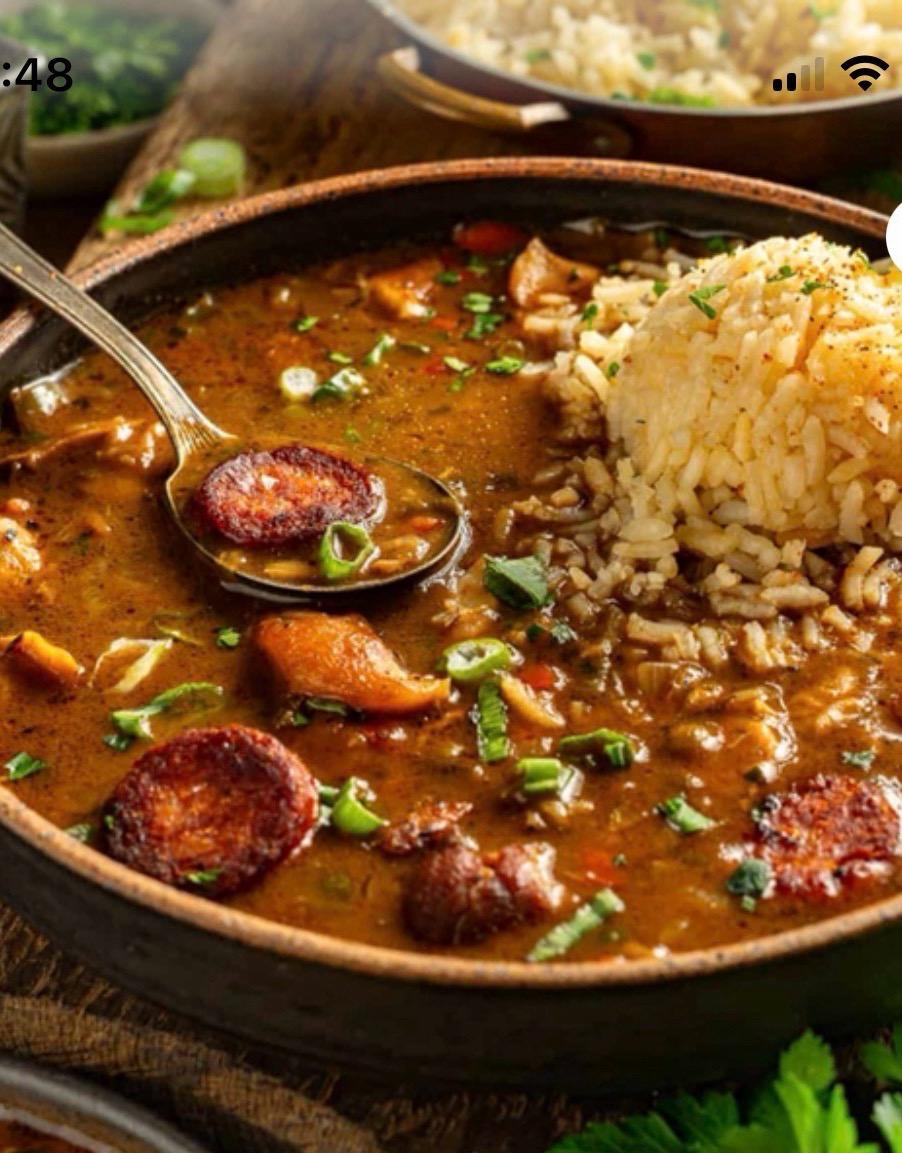
GUMBO DU MONDE
This is by no means a "definitive" gumbo recipe. There are an almost infinite number of ways of making gumbo, but this is the way I make it. (There are several other gumbo recipes on my gumbos and soups page.) I say with no trace of arrogance and with complete honesty that this may well be the best gumbo you've ever had. I call this my "everything" gumbo. It's a bit unusual in that the chicken stock is also infused with a seafood flavor from the shrimp shells and heads, and that it contains chicken, sausage and seafood. I believe this makes for a much richer and more complex set of flavors for the gumbo. Get this recipe while you can -- if I ever end up serving this in a restaurant I'm not going to give my secrets away anymore ... :-) Remember that you MUST go through the stock making process for this dish; plain water or a canned stock will simply not do. I cannot overemphasize the importance of this step. Yes, you'll see gumbo recipes that call for plain water, but I do not believe that it's worth it to make a gumbo this way. You simply cannot get the depth and multi-layered complexity of flavors without starting with a homemade stock. Don't believe me? Listen to one of your fellow Gumbo Pages readers who wrote me and said, "Just wanted to tell you that I used your recipe off the Gumbo Page, and went ahead, on your pleading, and spent a whole day making the stock. It's the best gumbo I have ever made." -- Bill D. So there. The stock can be made in advance and refrigerated or frozen. A couple of alternate versions: Some people really don't like okra. I feel sorry for these people. You can convert this from an okra gumbo into a filé gumbo by omitting the okra, and when the gumbo's finished turning off the heat, sprinkling 1 to 2 teaspoons of filé powder over the surface of the gumbo. Cover and let stand for 15 minutes, then stir the filé powder into the gumbo. Once this has been done, any leftover gumbo may only be gently reheated; if this is brought to a boil again, the filé will turn stringy and have an unpleasant consistency. Also, if you want a more elegant-looking gumbo (rather than this version, which is rather rustic), remove the chicken from the bones, cut into chunks and add the meat back to the gumbo; also, instead of using whole crabs that you have to crack, omit them and add a pound and a half of good white crabmeat along with the shrimp near the end of cooking. DO NOT under ANY CIRCUMSTANCES use the artificial crab substitute known as "krab" or "surimi". If you ever serve anything like this to a Louisianian, you'd better be prepared to run for your life.

Ingredients
- 8 qtCold Water
- 8 lbchicken parts, (backs, necks, etc.) and bones, or a whole chicken, cut up and skillet-browned
- shells and heads, reserved from the 4 pounds of shrimp that have been peeled for the final step of the gumbo
- 8 ozOnion, chopped
- 4 ozCelery, with tops, chopped
- 4 ozCarrot, chopped
- 2heads garlic, cut in half horizontally
- 1 tspblack peppercorns, or so, cracked
- parsley stems, A few
- 1Bay Leaf
- 0.5 tspdried thyme leaves
- 0.5 tspdried tarragon leaves
- 0.5 tspdried oregano leaves
- 0.5 tspdried basil leaves
- 1.25 cupFlour
- 1 cupOil
- 1chicken or guinea hen, without giblets, cut up
- 1 lbandouille sausage, sliced about 1/4" thick on the bias (you may substitute hot or mild smoked sausage if good andouille isn't available) and/or fresh Creole hot sausage, browned
- 4 lbShrimp, peeled and deveined
- 6Blue Crab, cleaned, broken in half and claws pulled off (or for a more elegant looking gumbo, omit and instead add 1-1/2 pounds lump white crabmeat, picked over for shells and cartilage)
- 3 lbOkra, sliced
- 2Onion, chopped
- 1 bunchGreen Onions, with tops, chopped
- 2Bell Peppers, chopped
- 5ribs celery, chopped
- Garlic, several, minced
- 3bay leaves
- 1 bunchfresh parsley, chopped
- Creole seasoning, to taste
- black, white and cayenne peppers, to taste
- Salt, to taste
- Tabasco, Few dashes, or to taste.
- 1 tbspfilé powder
- Steaming hot Louisiana long-grain rice
Instructions
- 1
Remember that the rice goes in the bowl first, and it is not an optional step, despite the trend among some New Orleans restaurants to serve a riceless gumbo.
- 2
You may, if you like, sprinkle a small amount of gumbo filé in your individual serving for a little more flavor; just remember that if you're making a filé gumbo, it should be added to the pot off the fire for its proper thickening action.
- 3
Remove the skin from the chicken and chop into 3-4 inch pieces, making sure to cut through and expose the bones.
- 4
Brown the chicken parts and bones in a skilliet with oil, or in a 350°F oven for about 20 minutes.
- 5
Put the chicken in the stockpot with the water and bring slowly to a simmer.
- 6
Periodically skim off any scum that forms, and if you wish use a skimmer to skim off the fat.
- 7
Let this simmer for at least three, and preferably four hours.
- 8
Add the onion, garlic, carrots and celery.
- 9
Place the peppercorns, parsley sprigs and dried herbs into a 4-inch square piece of cheesecloth or large tea ball (making what's called a sachet d'epices) and tie it into a little sack; add the sack to the stock (you can tie the sack closed with some twine and tie the long end of the twine to the handle of the pot; this makes the bag easier to retrieve.)
- 10
Simmer for one more hour, then add the shrimp shells and heads.
- 11
Simmer an additional 30 minutes.
- 12
Strain thoroughly; the best way to do this is to ladle the stock out and pour it through a strainer which has been lined with a couple of layers of damp cheesecloth.
- 13
If you're using the stock immediately, skim off as much fat as you can with a fat skimmer or a piece of paper towel, otherwise cool the stock right away by placing the container into an ice-water-filled sink, stirring to bring the hot liquid from the center to the sides of the container.
- 14
To defat the stock easily, refrigerate so that the fat solidifies on the surface, then skim off.
- 15
Use it all for this gumbo recipe.
- 16
Blend [flour and oil] thoroughly in a thick skillet and cook over medium-high to high heat, stirring CONSTANTLY.
- 17
Keep cooking and stirring until the roux gets darker and darker.
- 18
You should turn the fire down as the roux approaches the right color because the heat from the pan will continue cooking it.
- 19
Add your onions to the roux as it's near the end of cooking to arrest the cooking process and to soften and caramelize the onions (this is the way I like to do it).
- 20
KEEP STIRRING.
- 21
Once the roux is at the color you want add the bell peppers and celery and continue to stir until the roux is relatively cool.
- 22
Add the roux to the stock.
- 23
Sprinkle the chicken pieces with Creole seasoning and brown in the oven.
- 24
Slice the sausage and brown, pouring off all the fat (especially if you're using fresh Creole hot sausage).
- 25
Sauté the onions, green onions, bell pepper and celery if you haven't already added them to the roux, and add to the stock.
- 26
Add the chicken and sausage(s).
- 27
Add the bay leaves and Creole seasoning (or ground peppers) to taste and stir.
- 28
Bring to a boil and immediately reduce to a simmer; let simmer for about 45 minutes.
- 29
Keep tasting and adjusting seasonings as needed.
- 30
Add the okra and cook another 30 minutes or so.
- 31
Make sure that the "ropiness" or "stringiness" from the okra is gone, add the parsley, crab halves and claws (if you're using them).
- 32
Cook for another 15 minutes, then add the shrimp (and if you've omitted the hard-shell crabs, add the lump crabmeat now).
- 33
Give it another 6-8 minutes or so, until the shrimp are just done, turning pink.
- 34
Be very careful not to overcook the shrimp; adding the shrimp should be the very last step.
- 35
If there is any fat on the surface of the gumbo, try to skim off as much of it as possible.
- 36
Serve generous amounts in bowls over about 1/2 cup of hot rice -- claws, shells, bones and all (if you've made the original "rustic" version).